
Textile Art for Modern Interiors That Holds Attention
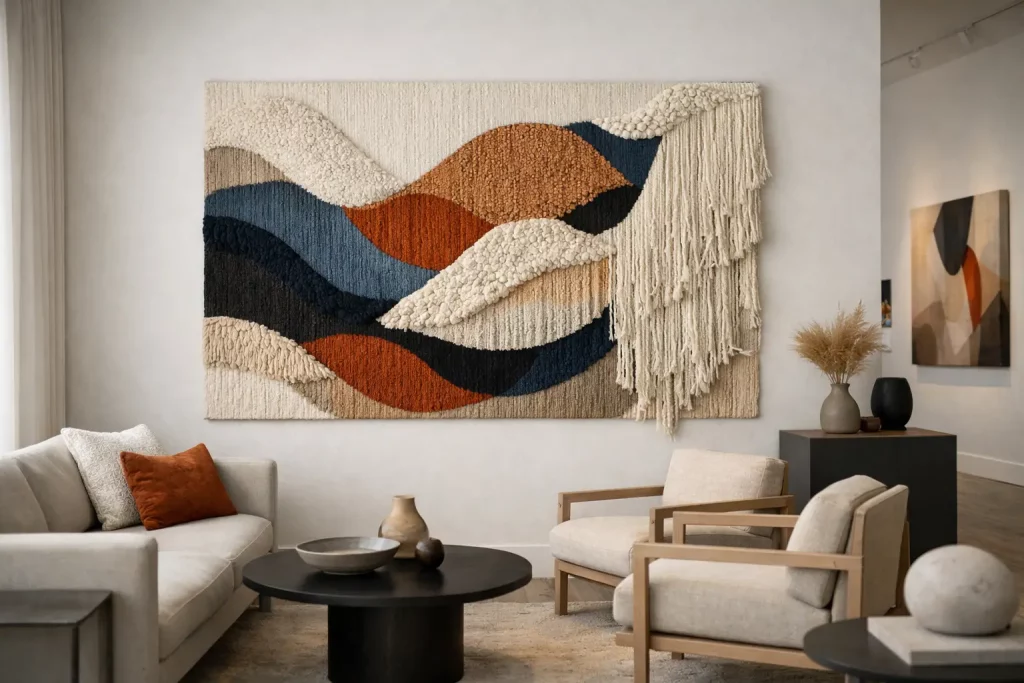
A room can be spare, polished, and architecturally precise, yet still feel unfinished. Textile art changes that condition without merely adding decoration. Through fiber, relief, tension, absorbency, and irregularity, it introduces a physical presence that painting or photography may approach differently. For artists, textile art for modern interiors is not a styling category. It is a serious framework for considering how a work occupies space, photographs, travels, and meets a collector’s daily life.
The strongest works do not simply match a palette or soften a wall. They establish a visual argument between material and architecture. A hand-worked surface can make an austere interior more attentive to touch; a monumental woven composition can alter a room’s sense of proportion. This relationship is why textile-based practices have gained particular relevance in contemporary residential, hospitality, and public-facing spaces.
Textile Art for Modern Interiors Is Spatial Art
Textile work is often discussed through craft terminology alone: weaving, tufting, embroidery, knotting, quilting, felting, and dyeing. These processes matter, but they are not the whole proposition. In an interior, the work is also read through silhouette, shadow, acoustic effect, and distance. Its materials respond to light across the day, while its texture invites a closer encounter than a flat image usually demands.
That does not mean every textile artwork must be large or tactile. A restrained, small-scale piece can be highly effective when its construction rewards proximity. Equally, a large work can function as a spatial anchor if it has enough formal discipline to hold a wall rather than dissolve into it. The relevant question is not whether a work is decorative. It is whether its visual decisions remain compelling after the initial recognition of its material.
For contemporary interiors, that distinction is essential. Many current spaces are built around clean planes, neutral finishes, and controlled lighting. Textile can either provide productive friction or become visual noise. Work with a clear compositional structure, a deliberate relationship to color, and a confident edge condition is more likely to retain its authority in such settings.
Material Carries Meaning
Fiber is never neutral. Wool, linen, cotton, silk, raffia, synthetic yarn, found fabric, wire, and recycled materials each arrive with different associations and practical behaviors. An artist working with salvaged garments may address labor, memory, consumption, or migration. One using industrial felt might foreground architecture, sound, repetition, or mass production. The material should not need an elaborate explanation to matter, but an artist should understand what it contributes to the work’s conceptual vocabulary.
Modern interiors often favor material honesty: timber that reads as timber, stone that retains its grain, metal with a visible finish. Textile art can sit naturally within this sensibility when the material is not disguised. A visible stitch, exposed backing, frayed edge, or irregular dye field can become part of the work’s intelligence. Conversely, high refinement may be the point. The decision depends on the artistic language, not on a generic expectation that fiber work must appear handmade.
There are practical trade-offs. Natural fibers may be sensitive to strong sunlight, humidity, insects, or airborne dust. Fragile projections may create difficulties in high-traffic areas. Heavy works require credible mounting solutions. These realities are not limitations to hide. They are part of professional preparation, especially when work is considered for private collections, exhibitions, or interior commissions.
Scale Must Be Considered Before Installation
A textile work can appear generous in a studio and unexpectedly slight above a sofa, in a hotel lobby, or along a long corridor. Scale is not only a measurement. It is a relationship between the dimensions of the artwork, the wall, the furniture below it, and the viewing distance available.
A useful discipline is to review the work in several contexts before presenting it publicly. Photograph it full-length against a clean wall. View it from across a room and at close range. Consider whether the upper edge, lower edge, and side profile are resolved. If the piece is intended to be suspended away from the wall, document the resulting shadow and depth. These details tell curators, designers, and collectors how the work behaves beyond the studio.
For larger textile art for modern interiors, modularity can be valuable. Panels that form a complete composition may allow more flexible installation and transport. Yet modular construction should emerge from the work’s visual logic. Dividing a composition solely to make shipping easier can weaken the image. A single, difficult object may still be the right artistic decision when its scale is integral to its impact.
Color Should Work With Light, Not Against It
Textile color is unusually variable. It can absorb light, reflect it, or shift according to the angle of a viewer. Pile direction, yarn density, dyes, metallic thread, and open weave all affect what the eye receives. This complexity gives fiber work a distinct advantage in minimal interiors, where a limited palette can become animated without relying on overt spectacle.
Artists should avoid assuming that neutral interiors require neutral textile art. A saturated work can create a precise focal point in a restrained room. Likewise, monochrome work can be powerful when value, relief, and surface variation carry the composition. What matters is intentionality. Color should support the work’s structure rather than compensate for an unresolved image.
Documentation is especially important here. Photographing textile art under flat, overly bright illumination can erase its physical depth. Images should show accurate color while also making construction legible. Detail shots are useful, but they cannot replace a full view that establishes scale and overall form.
Presentation Is Part of the Artwork’s Professional Language
Collectors and art professionals need to understand what is being offered, not just admire an atmospheric image. Each finished work should have clear dimensions, materials, year, and a concise description of the method when relevant. If a work includes unusual hanging requirements, indicate them plainly. If it is mounted, framed, stretched, or supplied with a hanging system, that information should be available in the portfolio.
A strong portfolio also distinguishes between installation views and artwork records. Installation images show how a piece inhabits an interior. Clean front-facing documentation supports curatorial review, inventory, and publication. Detail images demonstrate the material intelligence of the work. Together, they allow the viewer to move from atmosphere to evidence.
Avoid styling that overwhelms the work. A carefully selected interior can clarify scale and context, but excessive furniture, props, or color coordination can make the artwork seem subordinate to a design scheme. The goal is to show compatibility with contemporary space while preserving the work’s independence as art.
Build a Cohesive Body of Work, Not a Decorative Range
Artists entering the textile field can feel pressure to make work that is immediately adaptable to many rooms. That instinct may produce pleasant objects, but it rarely produces a memorable practice. A gallery, curator, or informed collector is generally looking for coherence: recurring formal questions, material decisions that develop over time, and a recognizable authorship.
Cohesion does not require repetition. One series may move from dense wall works to open structures or suspended forms, provided the shift has a visible conceptual relationship. What should remain clear is why these works belong to the same artist. Is the central concern gesture, domestic history, abstraction, ecology, language, repair, geometry, or the politics of material? The answer can evolve, but it should be present in the work before it is stated in the text.
This is also where artists should resist reducing textile practice to a trend. Interest in fiber-based art has expanded its visibility, but trends move quickly. A sustained practice is built through material rigor, thoughtful editing, and an understanding of where the work belongs within contemporary visual culture.
Positioning Textile Practice for Professional Review
When presenting textile-based work to a gallery, lead with the artwork rather than a broad claim about interiors. Interior relevance is a strength, but it should not replace the artistic proposition. A concise portfolio statement can identify the work’s concerns, followed by professional images and essential information about scale, materials, and installation.
It helps to show that practical considerations have been anticipated. If the work is fragile, explain the handling requirements. If it is intended for a particular spatial condition, demonstrate that condition through an installation view. If a series includes several formats, make the relationship between them easy to read. Clarity signals respect for the work and for the people evaluating it.
For artists seeking an international context for a developed textile practice, Parcus Gallery invites qualified artists to introduce their work and explore Representation & Collaboration: https://parcusgallery.com/representation-collaboration/
The most persuasive textile work does not ask an interior to validate it. It changes the terms of the interior itself, making wall, light, distance, and material newly visible.