Parcus Gallery
Parcus Gallery works with artists whose practice demonstrates artistic integrity, a distinctive visual or conceptual language, and the capacity to engage meaningfully with an international audience. We understand gallery representation as an ongoing professional relationship — one that creates context around an artist’s work, develops visibility, facilitates encounters with collectors and audiences, and opens possibilities for exhibitions, publications and projects across different countries and cultural environments. Our approach is selective, international and deliberately different from the conventional gallery model.
A Different Approach to Gallery Representation
The traditional gallery system has played an essential role in the development of the art market. It has built careers, supported artists and created some of the most important cultural relationships of the modern era. At the same time, its economic structure inevitably creates barriers. When a gallery assumes the entire financial risk of representing, promoting and exhibiting an artist, commercial predictability naturally becomes an important part of the selection process. Galleries are consequently able to represent only a limited number of artists, often favouring established networks, proven markets and careers that have already achieved significant recognition. This creates a familiar paradox: artists frequently need recognition to gain access to meaningful representation, while meaningful representation can itself be instrumental in building that recognition. Parcus Gallery was founded with the conviction that serious curatorial standards do not require us to reproduce every limitation of this traditional structure. We believe it is possible to preserve artistic discernment while creating a more open, transparent and balanced framework for professional collaboration. This philosophy influences not only how we select artists, but also how we approach participation, exhibitions, sales and commissions.
Art Comes First
Every relationship with Parcus Gallery begins with the work. We consider the quality, coherence and individuality of an artist’s practice, the strength of the body of work, its professional presentation and its potential relationship with the Gallery’s programme and international activities. An artist’s career may already extend over decades or may still be developing. Recognition and professional history are relevant, but they are not our only measures of artistic significance. We are interested in artists with something individual and meaningful to contribute. Financial participation never determines artistic acceptance. No artist becomes part of Parcus Gallery simply by paying a fee. Representation follows the Gallery’s consideration of the work and its decision that there is sufficient artistic and professional affinity to develop a relationship.
Representation as an Active Relationship
For us, representation should create movement around an artist’s work. Depending on the individual collaboration and the Gallery’s programme, this may include presentation through Parcus Gallery’s platforms, communication with our international audience, editorial and digital visibility, exhibitions, art fairs, institutional collaborations, publications and other opportunities developed by the Gallery. Our activities extend beyond a single exhibition space and are conceived internationally. Since its foundation in Berlin in 2017, Parcus Gallery has developed a programme connecting artists with audiences through exhibitions, international art fairs, cultural partnerships and its own communication platforms. Today, this ecosystem includes the Gallery’s physical and international projects, together with Parcus Magazine, Parcus TV and our digital platforms. Each serves the same essential purpose: to create context, visibility and meaningful encounters between art and people.
A Shared-Participation Model
Parcus Gallery operates through a model in which artists participate in the structure that supports their representation and its related activities. We consider transparency about this essential. Rather than limiting representation exclusively to artists whose established sales can finance the Gallery’s activities, we have chosen a model in which the practical and economic basis of the relationship is understood from the beginning. Depending on the chosen form of representation or on a particular project, artists therefore contribute financially towards the structure and activities connected with their participation. This contribution is not a payment for artistic approval, nor does it purchase curatorial recognition. It is participation in the practical structure that makes the collaboration possible. This approach gives the Gallery greater independence to consider artists for the quality and relevance of their work rather than exclusively for their immediate commercial predictability. At the same time, it allows us to develop a broader programme of international exhibitions, communication and professional opportunities. The artist knows the conditions of participation in advance and remains free to decide whether our model corresponds with their own objectives.
A Different Approach to Commission
The other side of this structure is equally important and represents one of the most distinctive aspects of the Parcus Gallery model. In the conventional commercial gallery system, commissions are normally established in advance and often represent a substantial percentage of every sale. Parcus Gallery does not impose a predetermined Gallery commission on the artist. When a work is sold, the artist is free to decide what commission they wish to allocate to Parcus Gallery. This decision may be made individually after each sale, without any requirement to establish a fixed percentage in advance. The principle is intentionally simple: The artist decides. Different sales may arise under different circumstances. The Gallery’s involvement may vary from one transaction to another, and the professional relationship itself may develop considerably over time. Rather than determining the value of that relationship through a compulsory percentage established in advance, we leave the artist free to decide what they consider appropriate. This freedom is not an exceptional arrangement or a temporary concession. It is an integral part of the Parcus Gallery model. We believe it provides artists with a degree of economic autonomy that remains unusual within the commercial gallery system and establishes a relationship based on professional freedom, reciprocity and trust.
Sharing Commitment and Responsibility
Shared participation and freedom of commission are two parts of the same philosophy. The Gallery contributes its structure, experience, international presence, communication channels, professional network, programme development and ongoing work. The artist contributes the work, the artistic practice and the agreed participation associated with their chosen form of representation. When a sale occurs, however, the Gallery does not automatically impose a predetermined division of the proceeds. The artist retains the freedom to determine the Gallery’s commission. This creates a relationship that is neither the conventional commission-based gallery model nor simply a fee-for-service arrangement. It is a professional partnership in which responsibilities are understood, costs are transparent and meaningful economic autonomy remains with the artist. Openness, however, does not mean absence of selection. Access and discernment are not opposites. Our objective is not to represent as many artists as possible, but to develop meaningful professional relationships within a structure capable of supporting them.
International Opportunities
Parcus Gallery develops opportunities in different formats and locations according to its international programme. These may include Gallery exhibitions, international art fairs, collaborative and institutional exhibitions, special projects, publications, editorial features and digital presentation. Specific exhibitions, fairs or external projects may involve additional costs, particularly where third-party expenses such as exhibition space, transportation, insurance, installation or external services are involved. Whenever this is the case, the applicable conditions are presented separately and in advance. Representation does not oblige an artist to participate in every project proposed by the Gallery. Each artist remains free to determine which opportunities correspond with their interests, career and priorities. We prefer a relationship based on informed choices and long-term dialogue.
Representation Framework
Parcus Gallery offers different Membership Plans according to the scope and duration of the relationship. Each plan establishes the practical framework of representation, including its duration, participation cost, services and opportunities. The conditions are presented clearly before any commitment is made. In particular circumstances — for example, when the nature of an artist’s career, a specific project or an exceptional professional situation calls for it — the Gallery may also structure an individual form of collaboration. What matters is that the relationship is clear, proportionate and understood by both sides from the beginning.
Sales
Public prices are established transparently and should take into consideration the artist’s existing market, career, objectives and the positioning of the work. When a sale is concluded, the artist is informed accordingly and remains free to determine the commission they wish to allocate to Parcus Gallery. There is no compulsory predetermined Gallery commission. This freedom is an integral part of our representation model.
Exhibitions and Projects
Throughout the year, Parcus Gallery develops and participates in exhibitions and projects in different cities and countries. Artists may be invited to participate according to the nature of each project, available space, curatorial context and practical conditions. Where participation involves additional expenses or specific conditions, these are communicated before any commitment is made. The artist remains free to accept or decline each individual opportunity.
A Relationship Built Over Time
We do not consider representation a promise of immediate sales. No serious gallery can guarantee how collectors, institutions or the market will respond to an artist’s work. What a gallery can do is create circumstances in which the work can be seen, understood, communicated and encountered. Recognition is often cumulative. An exhibition becomes part of an artist’s professional history. A publication creates another reference. An art fair introduces the work to a new audience. Digital communication extends its reach. A collector discovering an artist today may become a buyer much later. Over time, these encounters contribute to the visibility, credibility and context surrounding an artist’s career. Our role is to participate actively in that process.
What We Look For
There is no formula for an artist who belongs at Parcus Gallery. We value artistic quality, coherence, individuality and seriousness of practice. We are interested in work that possesses its own identity and in artists who understand representation as a professional relationship requiring communication and commitment from both sides. Career history, exhibitions, collections, publications and other professional achievements naturally contribute to our understanding of an artist’s trajectory, but they are considered within the broader context of the work itself. An established artist and an artist whose international trajectory is still developing cannot be measured by identical biographical expectations. Ultimately, we look for work we believe deserves to be seen — and for professional relationships we believe are worth developing.
Begin the Conversation
If the philosophy and approach of Parcus Gallery correspond with the way you would like to develop your relationship with a gallery, we invite you to introduce your work to us. The information requested below is intentionally concise. It allows us to understand who you are, your artistic practice and the form of representation you would prefer.
Your Information
Please provide:
Name: Date of birth: Nationality: Address: Postal Code and City: Country: Phone / WhatsApp: Email: Website: Are you business registered? VAT#___________
Please also provide a link to your website, portfolio or another online source where we can obtain a representative overview of your work and professional trajectory.
Your Preferred Membership Plan
Please indicate the Membership Plan that best corresponds with the form of collaboration you would like to pursue: Your choice of a Membership Plan does not constitute automatic acceptance and creates no contractual obligation. It simply allows us to understand the framework within which you would prefer a potential relationship with the Gallery to be considered. 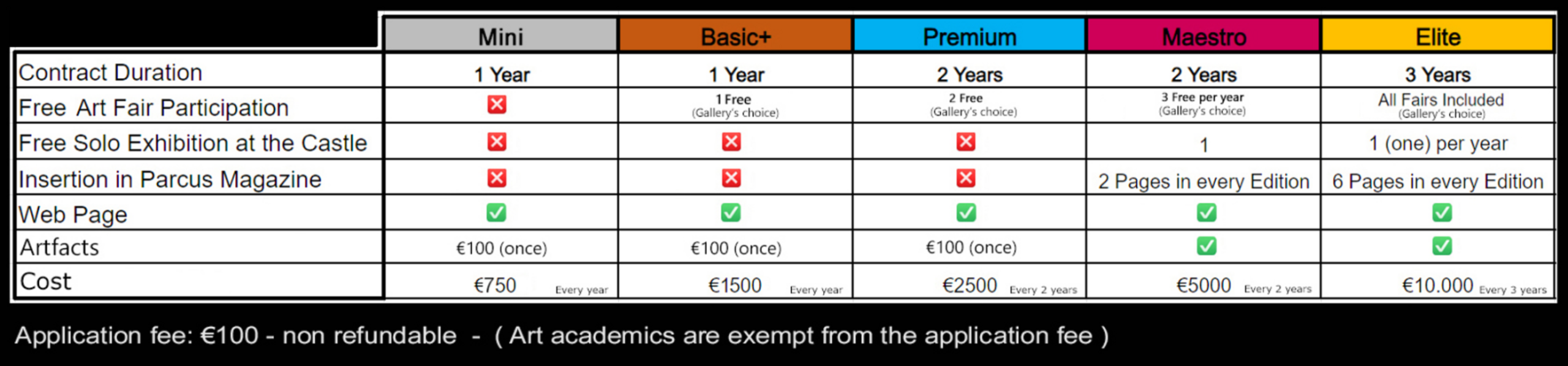
Pay the application fee here:
https://pay.sumup.com/b2c/QF1FSZU6
What Happens Next
Once we receive your information, preferred Membership Plan and sufficient material to understand your work and professional practice, Parcus Gallery will undertake a curatorial and professional review. The selection of a Membership Plan — or the artist’s willingness to participate financially in the Gallery’s structure — does not determine acceptance. If we consider that your work and professional practice are appropriate for Parcus Gallery, we will contact you and send the corresponding Representation Agreement for your consideration. The agreement will clearly establish the selected Membership Plan, duration of representation, the respective responsibilities of the artist and the Gallery, and the other practical conditions governing the relationship. You will have the opportunity to review these terms before making any commitment. Representation begins only after the agreement has been accepted and signed.
A Professional Relationship Begins with Understanding
Choosing a gallery is an important decision for an artist, just as choosing an artist is an important decision for a gallery. For this reason, we believe the relationship should begin with clarity rather than promises. Our purpose is to understand your work, your professional trajectory and what you expect from representation — and to determine whether Parcus Gallery can provide an appropriate context in which that relationship can develop. If there is mutual confidence in that possibility, we will be pleased to welcome you to Parcus Gallery.
Robert L Parcus Founder & Director Parcus Gallery
Castle Aistersheim - Austria Email: hello@parcusgallery.com Phone / WhatsApp: +43 676 750-6663