
Art Portfolio for Gallery Submission That Works
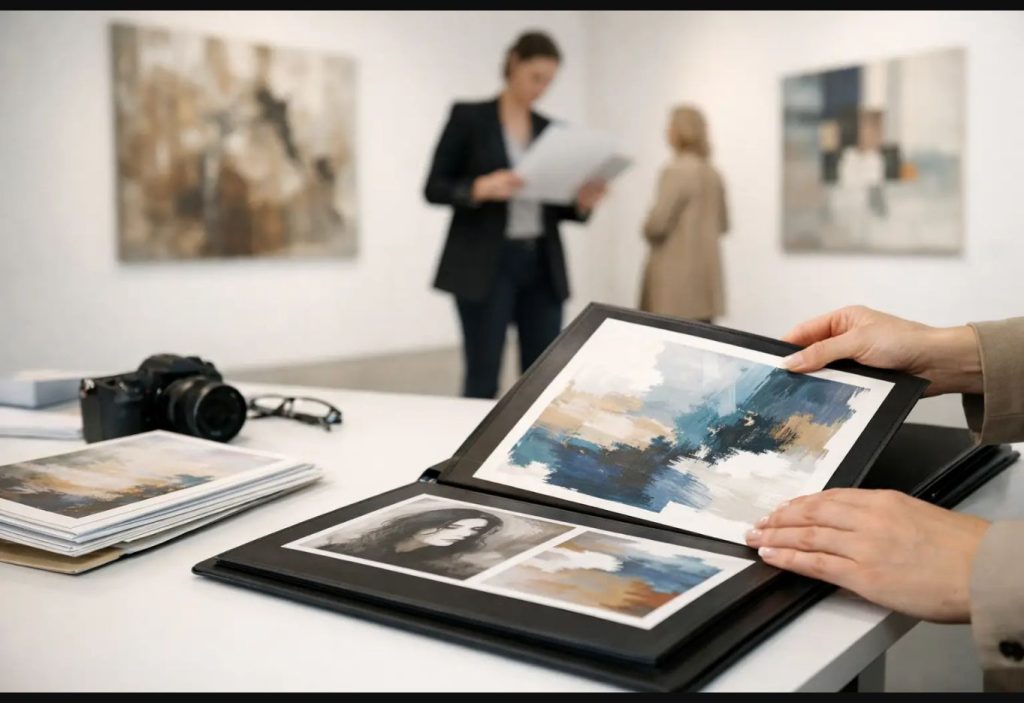
A strong art portfolio for gallery submission does not attempt to prove that you can make every kind of work. It gives a curator or gallery director a precise view of what you are doing now, why the work belongs together, and whether there is a sustained practice behind it. The most persuasive portfolios feel edited rather than assembled.
For artists seeking professional representation or exhibition opportunities, the portfolio is not simply a record of completed works. It is an introduction to your visual language, working methods, and direction. A reviewer should be able to understand the work quickly, then find enough depth to want a further conversation.
What a Gallery Needs to See
Galleries receive submissions from artists working across very different media, scales, and career stages. The practical details vary, but the central question remains consistent: is there a coherent body of work with a distinct point of view?
Coherence does not mean every work must use the same palette, subject, or format. It means the decisions within the work appear intentional. A photographer may move between portraiture and landscape while maintaining a recognizable attention to light or social context. A painter may work in several series if they share a formal or conceptual logic. A sculptor may use changing materials while pursuing a clear set of spatial concerns.
Your portfolio should make that logic visible. If a reviewer has to search through unrelated projects to locate your strongest work, the submission becomes harder to assess. Editing is therefore not a cosmetic step. It is curatorial thinking applied to your own practice.
Building an Art Portfolio for Gallery Submission
Start by selecting work that represents your current direction, not your entire history. For most submissions, a focused group of approximately 10 to 20 works is more useful than a large archive. The exact number depends on the application requirements and the nature of the practice. Installation-based artists may need fewer, more fully documented projects; artists with a tightly developed two-dimensional series may include a broader selection.
Choose work from a reasonably recent period unless an older piece is essential to explain the development of the current body of work. Reviewers are usually trying to understand what you can continue to make, exhibit, and develop. Early student work, experiments that no longer relate to your practice, and pieces included only because they have sold or received attention can weaken that picture.
Arrange the images with intention. Lead with a work that establishes the visual character of the portfolio, then create a sequence that shows variation without losing focus. Consider rhythm: a close detail may follow a full installation view; a quieter image may give space after a visually dense work. The final image should leave a clear impression of the practice rather than introduce an entirely new direction.
It can help to make two edits before choosing a final version. First, create a generous selection without judging it too quickly. Then reduce it sharply. Ask which works would be missed if removed. If the answer is unclear, leave them out.
Use Images That Describe the Work Accurately
Poor documentation creates uncertainty, even when the work itself is compelling. Images should be sharp, correctly exposed, and faithful to the color, texture, scale, and material presence of the artwork. Avoid heavy filters, inconsistent cropping, busy backgrounds, or images that make it difficult to identify the work’s edges.
For painting, drawing, photography, and textile work, include a clean full view as the primary image. Detail images can be valuable when surface, process, or material is central to the piece, but they should support rather than replace the full view. For sculpture and installation, include multiple angles when necessary, along with a view that communicates scale and the relationship to space.
Avoid presenting mockups as if they were exhibition documentation. A mockup may help communicate a possible scale or display context, but it should be clearly identified. Galleries need to understand what has actually been made and how it exists physically or digitally.
Every work should have consistent captions: title, date, medium, dimensions, and availability when requested. Use a format that is easy to scan. Dimensions should be clear about height, width, and depth, and digital works should state their edition, format, or display requirements where relevant. Administrative precision signals respect for the work and for the reviewer’s time.
Write a Statement That Supports the Images
An artist statement should not translate every artwork into a fixed meaning. Its role is to give language to the questions, references, materials, and processes that shape the practice. A clear statement can help a reviewer see connections that may not be immediately visible in the images alone.
Keep it specific. Replace broad claims such as “my work explores identity and emotion” with the particular conditions, materials, histories, or experiences you are examining. If you work with found textiles, explain what draws you to their prior use, pattern, or cultural associations. If your photographs involve constructed scenes, describe the decisions behind staging, location, and gesture.
A statement of roughly 150 to 300 words is often sufficient unless an application asks for something different. Write in direct language and avoid theoretical terms that do not clarify the work. You do not need to make the practice sound more complicated than it is. The aim is not to close interpretation, but to offer a credible framework for it.
Your biography serves a different purpose. It should provide concise professional context: where you are based, education if relevant, selected exhibitions, residencies, publications, awards, collections, or other milestones. Emerging artists should not try to fill a biography with every group exhibition or short course. Select what best reflects the stage and direction of the practice.
Match the Submission to the Gallery
A portfolio is stronger when it is sent to a gallery whose program has a genuine relationship to the work. This is not about finding an artist whose work looks identical to yours. It is about recognizing curatorial interests, media represented, and the kind of artistic dialogue a gallery creates.
Before applying, study the gallery’s artists and exhibition activity. Consider whether your work could be understood within that broader context while retaining its own position. A gallery with an international program may be looking not only at individual works, but also at an artist’s capacity for sustained visibility across different audiences and settings.
Follow the stated submission process exactly. If a gallery requests a PDF, do not send a folder of unlabelled image files. If it asks for a specific number of works, respect that limit. If there is an official artist application pathway, use it rather than sending repeated informal messages through unrelated channels. Professionalism often appears in these small decisions.
A short cover note is enough. Introduce yourself, identify your medium and location, mention why the gallery is relevant to your practice, and state what is attached or submitted. Do not make claims about guaranteed fit or ask for an immediate decision. The purpose of the note is to make the submission easy to place in context.
Common Problems That Dilute a Portfolio
The most frequent problem is excess. Too many works, too many series, and too much explanatory text can obscure an otherwise compelling practice. A portfolio should create confidence through selection, not volume.
Another issue is inconsistency between the images and the written material. If the statement describes a socially engaged installation practice but the portfolio contains only studio photographs of unrelated objects, the reviewer lacks the evidence needed to understand the claim. The text and documentation should reinforce one another.
Artists also sometimes submit work that is visually resolved but professionally incomplete. Missing dimensions, unclear materials, unavailable files, or a biography that has not been updated can create avoidable friction. These details do not replace artistic quality, but they shape how readily a gallery can evaluate and potentially present the work.
Finally, do not send the same portfolio indefinitely. Your practice changes, and the document should change with it. Revisit it after a new series, a significant exhibition, or a shift in materials. A portfolio is most effective when it reflects a living practice rather than a fixed archive.
Presenting a Practice With Direction
Gallery submission is not a test of whether your work is universally appealing. It is a question of fit, timing, and the clarity with which you present your practice. Rejection or silence can reflect a gallery’s current program, capacity, or curatorial priorities rather than a final judgment on the work.
For artists considering representation, the goal is to show both the strength of the present work and the seriousness of the path ahead. Parcus Gallery’s artist application process, like any professional submission route, is best approached with a portfolio that is concise, current, and grounded in a clear artistic direction.
The most useful portfolio leaves a reviewer with a simple, durable impression: this artist knows what they are making, has made it with care, and has more to say.
Qualified artists seeking professional representation may review Parcus Gallery’s Representation & Collaboration page and introduce their work through the official application process.