
 ›
› - Title
- Orang Utan
- Artist
- Reinhard Riedel
- Year
- 2026
- Technique
- Oil on canvas
- Style
- Contemporary
- Dimensions
- 38 × 38 × 2 cm
- Availability
- AVAILABLE
Artwork statement / Remarks
Composition and Presence
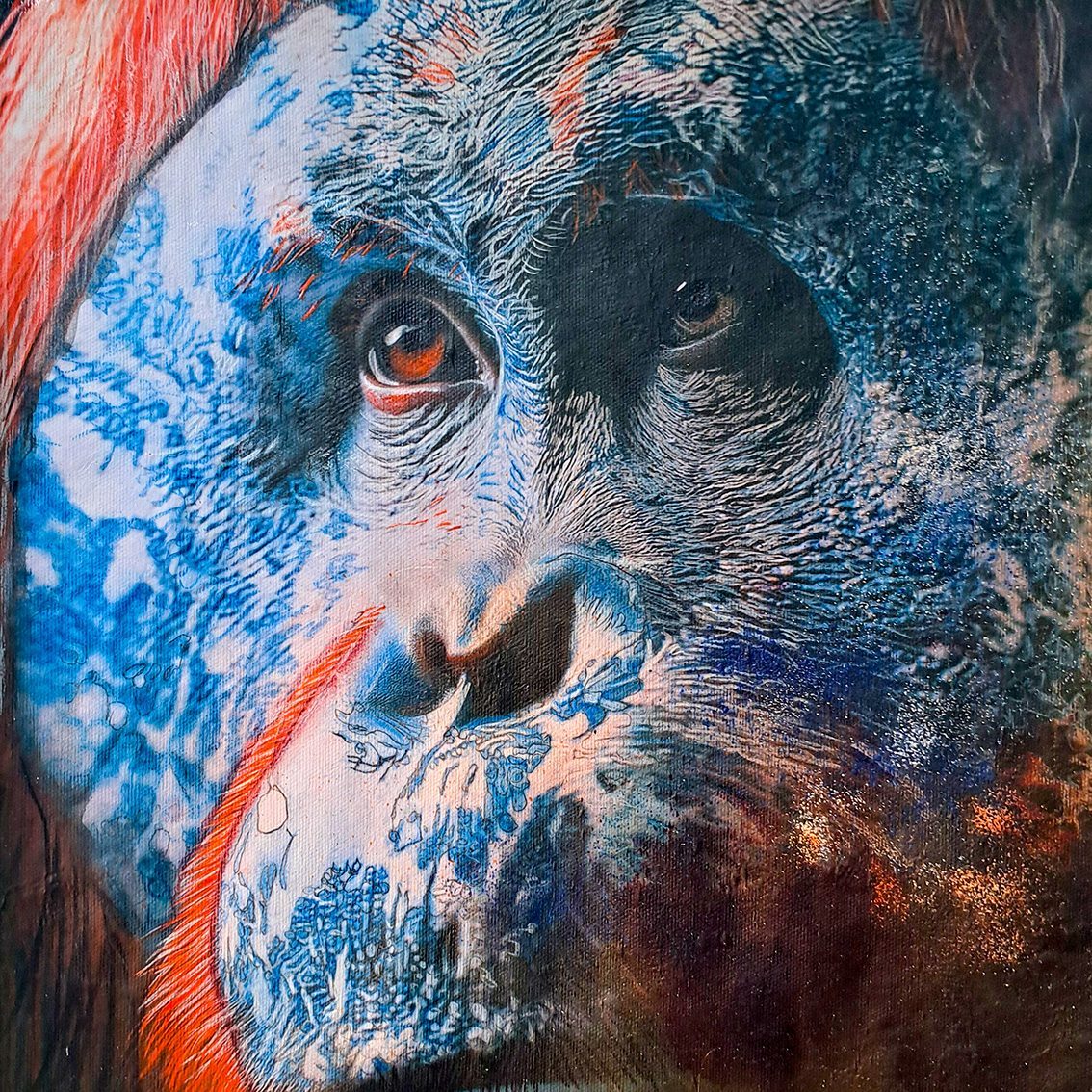
The work depicts the head of an orangutan in extreme close-up, with the animal’s striking, downcast gaze and characteristic facial shape filling the frame right to the edge of the image. The asymmetrical visual effect—shaded on the right and more strongly lit on the left—lends the face a sculptural, almost relief-like three-dimensionality and recalls the compositional close-up strategy that already characterized the chimpanzee portrait in the series.
Color Dramaturgy
Unlike most of the animal portraits in the series, no naturalistic fur color is discernible here—instead, an intense, iridescent blue palette dominates, interspersed with bright orange-red accents, revealing the orangutan’s characteristic reddish fur in its original color only at the left edge of the image. This radical color distortion of the face itself creates an almost cool, detached effect that stands in stark contrast to the warm, natural fur color at the edge—a deliberate break between “distorted” and “original” depictions of the animal within a single work.
The Eyes as an Emotional Anchor
The left, amber-colored eye, with its precise glint of light, forms the only warm, “lively” splash of color in the otherwise cool-blue face, thereby immediately drawing attention to itself. The right eye, on the other hand, disappears almost completely into the shadows—only a small point of light hints at its presence. This unequal treatment of the two eyes creates a subtle asymmetry in the expression, which lends the gaze a lasting alertness and attentiveness despite the strong color distortion.
Technique and Surface Treatment
The facial skin is covered with dense, fine lines and an almost crystalline, textured pattern reminiscent of frost, cracks in ice, or mineral deposits. This texture differs markedly from the softer, more painterly rendering of fur in other works in the series and lends the face a hard, almost petrified surface quality. The red linear accents on the forehead and cheek appear like veins or cracks shining through the blue surface.
Interpretation
The alienation of the face in blue, while preserving the natural coloration at the edges, can be interpreted as a representation of an inner state—coldness, rigidity, or emotional distance that overshadows the animal’s inherently warm and expressive nature. The alert, amber-colored gaze, however, breaks through this rigidity and asserts an unbroken inner vitality.
Conclusion
A technically bold work that, through its radical color distortion and crystalline surface texture, introduces a new, cooler dimension of expression into the series, demonstrating just how far the characteristic visual language of this series can be experimentally stretched without losing its core emotional message—the dignity and presence of the animal’s gaze.