
What Artists Should Expect From a Gallery That Truly Works
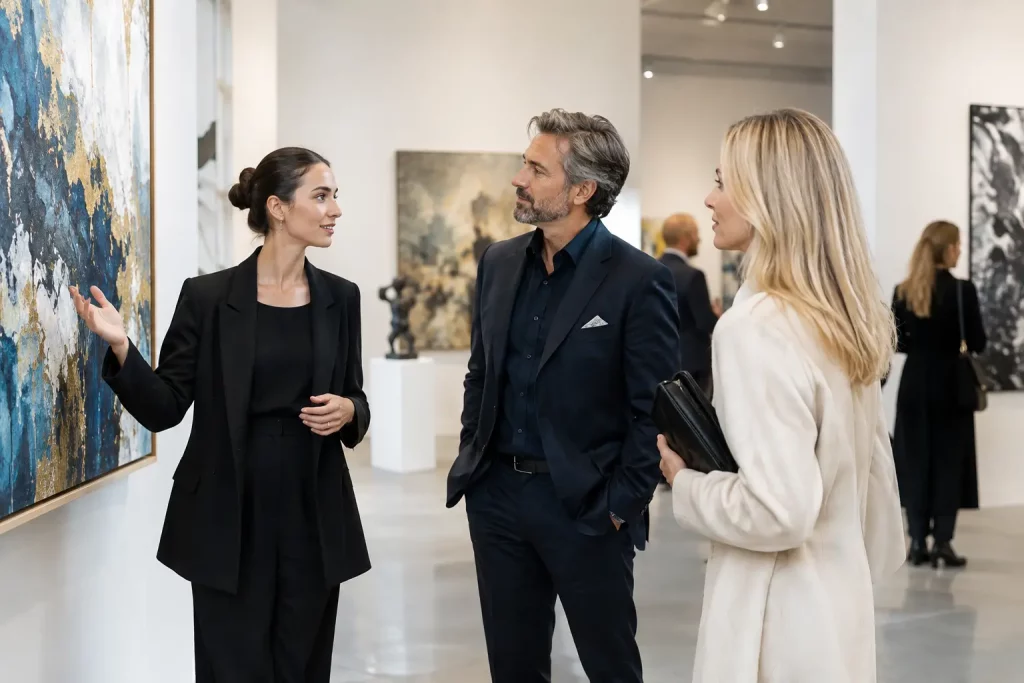
A strong body of work can be ready for a wider audience long before the right professional structure appears around it. What Artists Should Expect From a Gallery That Truly Works for Them is not simply a place to hang work or add a name to a biography. It is an active relationship that creates credible, repeated ways for your work to be encountered, understood, and remembered.
For many artists, the frustration is familiar. You may have a coherent practice, a considered visual language, and the discipline to continue developing it, yet your visibility still depends on scattered posts, one-off invitations, or the unpredictable reach of self-promotion. Those efforts matter, but they are not the same as representation built to support your next professional stage.
A gallery should create momentum, not just a listing
Being listed by a gallery and being actively represented are very different experiences. A listing can confirm that your work exists within a roster. Active representation gives that work a continuing professional presence: it is presented, documented, introduced in relevant contexts, and given more than one opportunity to reach new viewers.
This does not mean a serious gallery can promise a particular outcome. No responsible institution can guarantee sales, press attention, or immediate recognition. What it can do is establish a framework in which your work is not left to wait quietly for discovery. It is brought into circulation through deliberate activity.
That distinction matters because artistic careers rarely move forward through one dramatic moment. They develop through accumulation. A well-presented exhibition image, a carefully maintained artist profile, a publication feature, an art fair presentation, and a meaningful digital record can each become part of the larger professional picture. Over time, this makes it easier for curators, collectors, writers, and audiences to understand that your work has continuity behind it.
What artists should expect from a gallery that works for them
The first expectation is sustained visibility. Not visibility for its own sake, and not a short burst of attention that disappears when an exhibition closes. Your work should have opportunities to appear across physical and digital settings over time, with each appearance reinforcing its professional identity.
That visibility needs context. A gallery should know how to present your work as more than an isolated image. The way it is photographed, titled, described, installed, and placed alongside other practices affects how it is read. Strong presentation does not impose a story that is not yours. It gives your work enough clarity and structure for others to approach it seriously.
You should also expect a gallery to understand that an international career is built through access to more than one local conversation. For some artists, this may mean exhibition activity across different cities. For others, it may mean reaching viewers through publishing, digital presentation, or art fair participation. The right mix depends on your medium, your stage of development, and the direction of your practice. What matters is that the gallery is working from a larger field of possibility rather than treating geography as a limit.
Credibility is another essential part of the relationship. Your work benefits when it is associated with a professional institution that maintains clear public channels, documents its activity, and presents artists consistently. This is not about borrowing prestige. It is about placing your practice in an environment where serious attention has somewhere to land.
Presentation is part of the work’s future
Artists often think of presentation as something that happens after the studio work is complete. Professionally, it is part of how the work continues its life. A compelling series can lose force when images are inconsistent, information is difficult to find, or the work is shown without a clear frame. Conversely, precise presentation can help viewers see the decisions, material intelligence, and continuity already present in the practice.
A gallery that works for you should take this seriously. It should treat accurate artwork information, visual documentation, artist biography, and exhibition history as practical tools, not administrative afterthoughts. These materials help someone who encounters your work for the first time move from curiosity to understanding.
There is a trade-off here. Greater exposure can bring more varied audiences, and not every audience will respond in the same way. But broad visibility does not require your work to become generic or overly explained. The right professional setting protects the distinctiveness of your practice while making it legible to people beyond your immediate circle.
Repeated opportunities are more valuable than isolated promotion
A single feature can be useful. A single exhibition can be meaningful. Yet neither should be mistaken for a complete career strategy. Isolated promotion gives your work a moment; an active gallery ecosystem creates conditions for ongoing recognition.
Think of your professional presence as a body of evidence. Each considered appearance adds another point of reference. Someone may first encounter your work in an exhibition, later recognize it in an editorial context, and then find a detailed digital profile when they search for more. That sequence is more powerful than any single encounter because it shows that your practice is active, documented, and situated within a broader contemporary conversation.
This is also where digital discoverability has become increasingly relevant. Social platforms can support an artist’s visibility, but they are rented spaces with shifting rules and short attention cycles. Your career should not depend entirely on whether a post reaches the right person on the right day. A gallery should help build a more durable public record through platforms, publishing, searchable documentation, and professional communication.
Long-term development requires a real working structure
The best gallery relationship is neither passive nor frantic. It has continuity. The gallery understands what it is building with you, while remaining responsive as your work changes. Your practice may develop in scale, medium, subject, or ambition. A useful representative relationship makes room for that growth rather than reducing you to the first body of work that received attention.
You should expect thoughtful selectivity as well. A gallery that takes representation seriously cannot treat every application as interchangeable. It needs to consider whether the work is distinctive, coherent, professionally presented, and suited to the contexts it is able to create. Selectivity is not distance for its own sake. It is what allows a gallery to build relationships with intention.
Communication matters within this structure, but activity matters even more. It is reasonable to want clarity about how your work is being presented and what opportunities may be relevant. At the same time, mature professional development is not a calendar of instant results. It is a sustained process of positioning, visibility, and relationship-building.
From self-promotion to professional presence
Self-promotion has a place in every artist’s career. Your voice, process, and direct connection with audiences can be valuable. The limitation appears when you are carrying every role alone: artist, photographer, writer, publicist, event organizer, archivist, and salesperson. That arrangement can consume energy needed for the work itself.
A gallery should not erase your agency. It should give your agency a stronger professional setting. You remain the author of your practice. The gallery contributes the structure through which that practice can be presented more consistently and encountered more widely.
This is especially important when you are ready to move beyond occasional opportunities. If your work has reached a level of focus and you want it to be considered in an international context, the question is no longer simply where you can show next. The better question is what kind of representation can keep creating meaningful conditions for your work to be seen.
A structured international response
Parcus Gallery was founded in Berlin in 2017 and operates internationally from Europe, working with professional and emerging visual artists in the primary art market. Its approach combines artist representation with international exhibitions and art fairs, editorial publishing, media formats, digital platforms, and technologies intended to improve artist discoverability through search engines and AI systems.
This is significant because it addresses the difference between isolated promotion and a complete professional ecosystem. Through activity that includes Parcus Magazine, Parcus TV, Parcus Art ID, exhibitions, and digital presentation, artists can be documented and encountered across multiple channels rather than relying on one format alone. The gallery works through professional representation agreements and selective applications, reflecting a long-term view of professional collaboration.
For an artist, the value is not a promise that one action will change everything. It is the presence of a gallery structure designed to create repeated opportunities for visibility, presentation, and discovery while respecting the seriousness of the work.
The right gallery relationship should leave you with more than an exhibition credit or a name on a webpage. It should give your work a stronger place to stand, a clearer public record, and a professional setting capable of meeting the ambition you have already brought to the studio.
If this is the kind of gallery relationship you have been looking for
If you are looking for more than occasional exposure — and want your work to exist within an active, international and professionally structured gallery environment — Parcus Gallery invites you to introduce your work.
Applications are considered individually, with attention to artistic quality, coherence and professional potential.