
Live Interviews with Contemporary Artists
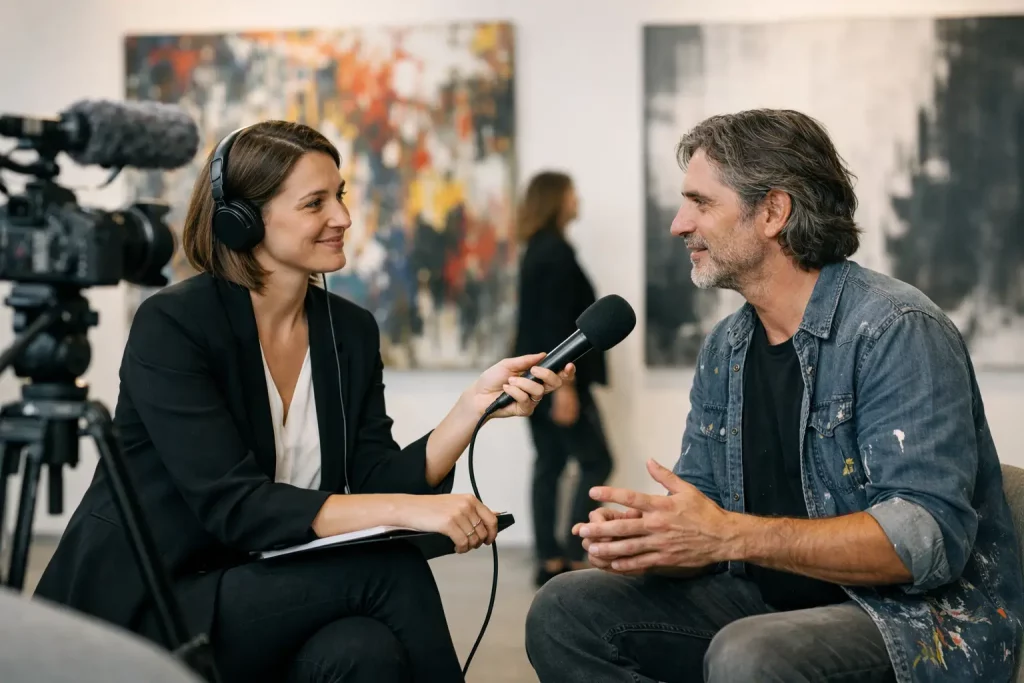
A finished artwork can carry an immediate visual charge, but it rarely explains the decisions that brought it into being. Live interviews with contemporary artists create room for that missing context: the material experiment that changed a work, the question behind a series, the slow development of a visual language, or the practical realities of sustaining a studio practice.
For artists, these conversations are not simply a promotional format. When approached with care, they are part of professional visibility. They make a practice more legible to curators, collectors, fellow artists, and audiences who may encounter the work first through a screen. The value lies less in performing certainty than in offering a precise, credible account of what the work asks and how it is made.
Why Live Interviews with Contemporary Artists Matter
Contemporary art is often received quickly. A viewer may see one image in a digital catalog, a social post, or a fair presentation before deciding whether to look further. An interview does not replace the artwork, nor should it attempt to explain every possible reading. It can, however, give the viewer an entry point: a way to understand the artist’s concerns without reducing the work to a caption.
This matters especially across international contexts. A painting, textile piece, photograph, sculpture, or digital work may travel far beyond the artist’s original community. Its references may be personal, regional, linguistic, or material. A live conversation can introduce that context in the artist’s own words while leaving space for the audience’s interpretation.
The format also reveals something a polished portfolio cannot always show: continuity. Viewers can hear how one body of work developed from another, why a certain medium became necessary, and what questions remain unresolved. For professionals assessing an artist’s direction, that sense of ongoing inquiry can be as meaningful as a single strong image.
The Interview Is Part of the Artwork’s Context
The best artist interviews stay close to the work. They avoid treating biography as a shortcut to meaning or asking an artist to turn every studio decision into a dramatic story. Instead, they examine the relationship between intention, process, form, and reception.
A useful conversation might begin with a specific work or current series. What drew the artist to this subject? What does the chosen material allow that another medium would not? Where does chance enter the process, and where does control matter most? These questions are direct, but they can open a serious discussion of composition, scale, time, memory, place, technology, labor, or the body.
For artists working in multiple disciplines, the interview can clarify relationships that are not immediately visible. A photographer who also makes sculpture, for example, may be pursuing one concern through different forms. A painter incorporating textile methods may be rethinking surface, authorship, or domestic histories. The conversation should make these connections available without forcing the practice into a neat formula.
There is a trade-off. Too much explanation can narrow the encounter with the work, particularly when ambiguity is central to the artist’s method. Too little, and the discussion becomes generic. The most effective interviews hold that tension. They offer language for the practice while recognizing that an artwork can exceed its maker’s stated intentions.
What Makes a Live Conversation Worth Watching
The word “live” changes the character of an interview. It introduces responsiveness. A thoughtful host can follow an unexpected point, return to a detail in the work, or allow a pause when the artist is considering a question. For the audience, this creates a sense of encounter rather than a scripted presentation.
Preparation remains essential. A live interview should be grounded in close looking and informed research, not improvised from broad questions about inspiration. The host needs to know the artist’s recent work, stated interests, and relevant materials well enough to ask specific questions. The artist, in turn, benefits from deciding which aspects of the practice can be discussed clearly and which require more time, privacy, or distance.
Clarity is more valuable than polish. Artists do not need to speak in institutional language to sound professional. A concise description of a working method is often stronger than a theoretical statement detached from the studio. It is equally acceptable to say that a question is still open. Contemporary practice is frequently built through research, revision, and uncertainty; an interview can acknowledge that reality.
Visual choices matter as well. If the work is discussed remotely, the audience should be able to see details, installation views, and shifts in scale where possible. A close view of a surface, a sequence of process images, or an image of the work in relation to the body can change how a viewer understands it. The goal is not spectacle. It is accurate attention.
Questions That Move Beyond the Artist Statement
An artist statement has a distinct function: it introduces a body of work in a concentrated form. An interview can go further by asking how the statement is tested in practice. Rather than asking, “What inspires you?”, a host might ask what changed between the first and final version of a work, what the artist removes before considering a piece complete, or how a recurring image has shifted over time.
Questions about professional development can also be useful when they remain specific. How does the artist edit a portfolio for different contexts? What does preparing for an exhibition reveal about the work? How do documentation and installation affect the practice? Such questions speak directly to emerging and established artists building a public presence without turning the conversation into career advice detached from the art itself.
Preparing to Speak About Your Practice
Artists are often more comfortable making work than describing it aloud. That is not a weakness. Still, a live format rewards preparation, particularly when an artist is presenting work to new international audiences.
Start by identifying two or three ideas that genuinely organize the current practice. They might concern a material, a research question, a recurring image, or an approach to form. These are not slogans. They are anchors that can keep an answer focused when a conversation moves across several works.
It also helps to prepare concrete examples. Instead of saying that a series addresses transformation, describe a decision within one work: the alteration of a photographic image, the accumulation of pigment, the handwork within a textile surface, or the use of a digital process that introduces instability. Concrete detail gives an audience something to remember.
Artists should resist the pressure to narrate an entire career in every answer. A strong interview has shape. It may center on a current series, a recent exhibition context, or a specific shift in the studio. Earlier work can be mentioned when it clarifies the present, but chronology alone rarely produces insight.
Finally, make room for the practical language of the studio. Scale, fabrication, sourcing, editing, failed attempts, and time are not secondary details. They often reveal the conditions under which a practice becomes distinctive. For collectors and curators, this information can also sharpen an understanding of what is materially at stake in the work.
From Conversation to Professional Visibility
A live interview has its greatest value when it becomes part of a coherent public record. A recorded conversation can support an artist profile, accompany a project, provide context for a new audience, and offer curators or collectors a more direct sense of the practice. Its role is cumulative rather than instant.
That does not mean every artist needs constant visibility. Frequency without substance can flatten a practice into content. A more selective approach is often stronger: speak when there is a real development to discuss, when a body of work has reached a meaningful stage, or when an audience needs context that images alone cannot provide.
For galleries, artist conversations can serve the same principle. They should center the artist and the work, not merely announce activity. At Parcus Gallery, a broader approach to representation and communication can include formats that help artists articulate their work across different audiences and professional settings. The standard should remain the same: accuracy, respect for the work, and a long view of artistic development.
A Conversation That Leaves Space for Looking
The measure of a successful interview is not whether it answers every question. It is whether it sends the audience back to the work with greater attention. A strong conversation gives an artist’s practice presence without making the artist perform a simplified version of it.
For artists building an international profile, that distinction is consequential. Speak with specificity, allow complexity where it belongs, and let the work retain its capacity to meet each viewer on its own terms.
Qualified artists seeking professional representation may review Parcus Gallery’s Representation & Collaboration page and introduce their work through the official application process.