
European Art Galleries Accepting Submissions
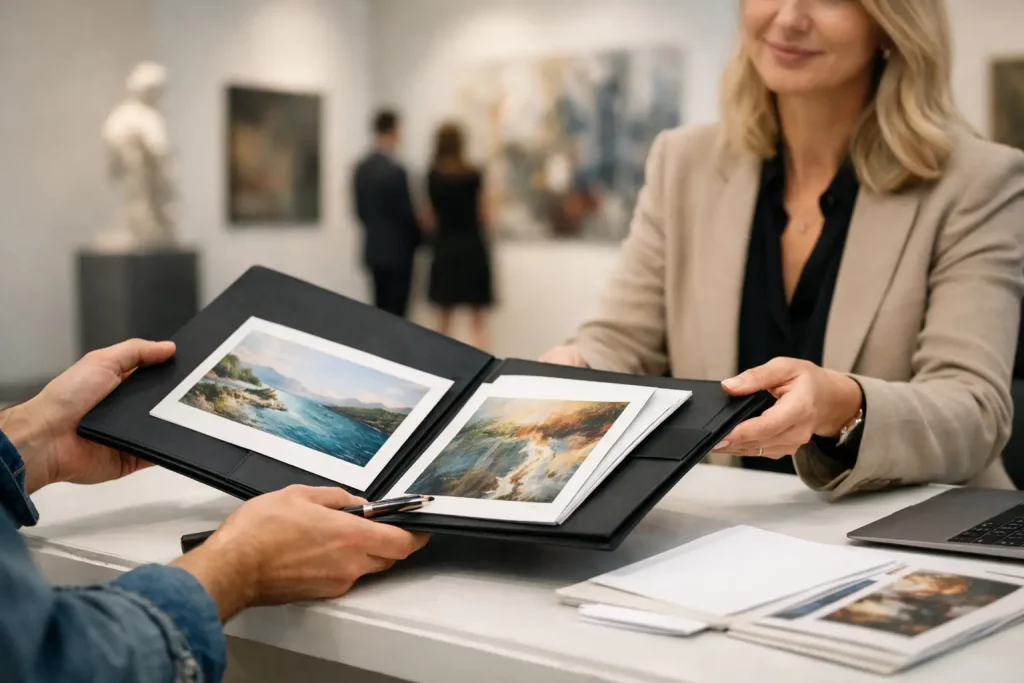
A submission is often judged before the first artwork is opened. An unclear email subject, an oversized attachment, or a portfolio that mixes several unrelated directions can make a serious practice difficult to assess. For artists seeking European art galleries accepting submissions, the task is not simply to find an open call. It is to present work in a form that allows a gallery to recognize its artistic coherence, professional readiness, and potential place within a program.
Gallery representation is a working relationship, not a listing. A considered application should show that you understand the difference. European galleries vary widely in scale, curatorial focus, commercial model, and geographic reach. The strongest submissions do not attempt to appeal to every gallery. They make a clear case for one artist, one body of work, and one credible next step.
What galleries assess in an artist submission
A gallery usually begins with the work itself. It looks for a distinct visual language, technical resolution, and enough consistency to suggest that the practice has direction. Consistency does not mean repetition. A painter may move between subjects, or a digital artist may work across formats, while maintaining a recognizable logic in material, composition, research, or visual rhythm.
The portfolio then provides context. Galleries need to understand what they are seeing: title, year, medium, dimensions, and availability are practical essentials. High-quality images matter, but documentation should remain faithful to the work. Excessive retouching, filters, or stylized mockups can obscure surface, scale, and material decisions that are central to evaluation.
Professional readiness also matters. This is not a demand for an extensive exhibition history. Emerging artists can be compelling candidates when their work is resolved and their presentation is organized. Still, a gallery needs evidence that an artist can communicate clearly, meet practical commitments, and sustain a body of work beyond a single promising image.
European art galleries accepting submissions: look for fit
The phrase “accepting submissions” can imply an open door, but it does not mean every applicant is suited to every program. A gallery focused on contemporary photography may admire a sculptor’s work while having no appropriate framework for representing it. Likewise, a gallery may have room for emerging practices in one medium but not another.
Before applying, study the gallery’s artistic focus. Consider the media it presents, the visual relationships among represented artists, and the level of career development reflected in its program. Look beyond whether the work is technically similar to yours. A useful question is whether your practice would create a meaningful conversation with the gallery’s existing context without merely duplicating it.
Geography has a practical dimension as well. An artist based outside Europe can still be relevant to a European gallery with an international outlook, but the application should make location, shipping realities, production capacity, and availability easy to understand. International representation requires communication and planning, not only artistic affinity.
Build a portfolio that can be reviewed quickly
Curators and gallery teams review many applications. A concise, well-edited portfolio respects that reality. Rather than sending every work made in the last five years, select a coherent group that represents the current direction of your practice. Around 10 to 20 works is often sufficient when each image adds something necessary to the overall presentation.
Place your strongest image first, but think about sequence. A portfolio should create momentum: a gallery should be able to see the central ideas, variations in scale or approach, and the level of finish without having to decode an archive. If your practice includes painting and textile work, for example, explain their relationship briefly rather than leaving the viewer to assume they are separate projects.
Your artist statement should support the images, not compete with them. One clear paragraph can establish the concerns behind the work, its materials, and its point of view. Avoid inflated language and broad claims about transformation, humanity, or innovation unless the images make those ideas specific. Precise language has more weight than dramatic language.
Include a short biography or CV with selected exhibitions, education, publications, residencies, awards, and relevant professional activity. Accuracy matters more than length. If an achievement needs explanation to sound substantial, it may not belong in a short submission CV.
Write the application as a professional introduction
The email or application form is not the place for a long account of your career. State who you are, where you are based, the medium or media you work in, and why you are approaching that gallery. A sentence showing real familiarity with the gallery’s direction can be valuable, provided it is specific and sincere.
Keep the practical elements easy to locate. Use a direct subject line, provide your website or portfolio details when requested, and follow file-size and formatting instructions. If a gallery asks for a PDF, do not substitute a folder of uncaptioned files. If it has a formal application process, use it rather than sending repeated messages through several channels.
Follow-up is a matter of judgment. If a stated review period has passed, one courteous message is reasonable. Repeated requests for updates rarely strengthen an application. A gallery may need time to review work collectively, consider programming, or decide whether a conversation is appropriate.
Consider the terms behind representation
Being accepted is only the beginning of a decision. Representation can involve exhibitions, promotion, digital communication, collector-facing activity, and longer-term career positioning, but the exact structure differs from gallery to gallery. Artists should read contracts carefully and understand responsibilities on both sides before entering an agreement.
Ask how artwork availability is managed, how sales commission is handled, who pays for production, transport, insurance, installation, and promotion, and whether there are participation costs connected to a representation plan or optional opportunities. There is no universal arrangement that is right for every artist. The relevant question is whether the terms are clear, proportionate to the proposed relationship, and workable for your practice.
It is also reasonable to ask how communication will function. A gallery relationship benefits from agreed expectations around inventory, pricing, new work, image use, exclusivity, and response times. These subjects are administrative, but they protect the conditions in which artistic work can develop.
Present a practice, not just a product
Artists sometimes approach galleries as though the goal were immediate placement of individual works. Sales are part of the primary art market, but a representation decision usually concerns something broader: the possibility of building an artist’s visibility and presence over time. Galleries consider whether they can speak credibly about the work to collectors, curators, and audiences, and whether the artist’s practice can continue to evolve.
That is why a portfolio benefits from evidence of thought beyond finished objects. Installation views, details that clarify process, and a concise project description can be useful when they genuinely illuminate the work. They should not overwhelm the central selection. The artwork remains the argument.
For artists looking toward international representation, Parcus Gallery offers qualified visual artists a route to introduce their work and explore Representation & Collaboration. Artists choose the gallery’s sales commission percentage themselves, including the option of 0%. Applicants should review the representation plans, participation costs, optional opportunities, and complete terms before deciding whether the relationship suits their objectives.
A thoughtful submission does not need to predict the outcome. Its purpose is more disciplined: to give the right gallery an accurate, memorable view of a practice that is ready to be considered. That clarity is often the most persuasive part of an artist’s introduction.