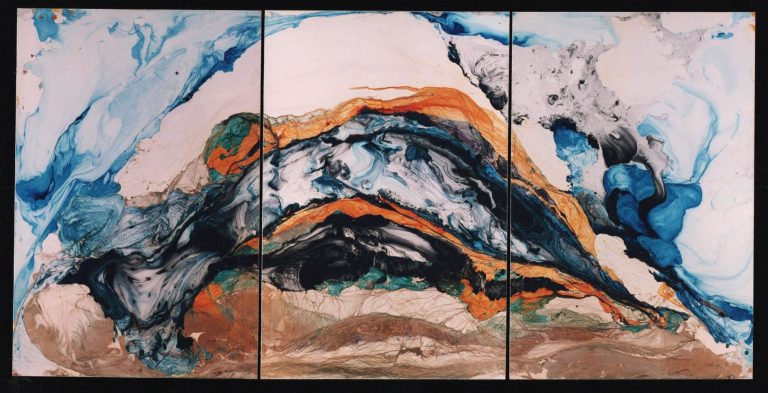
“A little more sun — I was an ember. A little more blue — I was beyond”. Work inspired by the poetry of portuguese poet Mário de Sá-Carneiro
Year: 1990
Technique: mixed technique and gold leaf on canvas
Dimensions: 146 × 297 × 4 cm
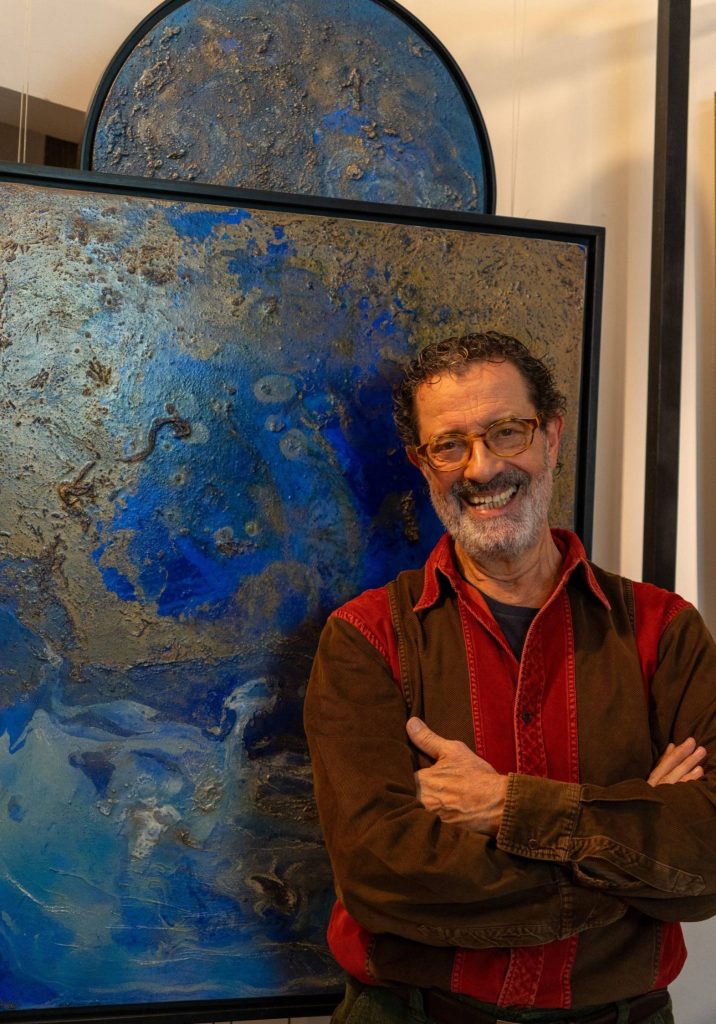
Paulo Cardoso
Brief Biography
Born in Lisbon in 1953. After completing his studies in Chemistry, he simultaneously attended the National Conservatory and the Lisbon School of Fine Arts.
In 1977, he developed an interest in astrology, and from 1978 onwards, he collaborated on various music, theater, and film productions as a set designer and painter:
• "Satie I" and "Satie II": productions organized by Catalan composer Constança Capdeville and pianist João Paulo Santos, presented at the National Conservatory of Lisbon, the Calouste Gulbenkian Foundation’s Auditorium 2, and the São Luís Theatre in Lisbon.
• "Eric Satie - Picasso" and "Stravinsky": both presented at the Capuchos Music Festival in Costa da Caparica.
• "O Bobo da Corte" (The Court Jester): a film by José Álvaro de Morais. This work won the Grand Prize at the Locarno International Film Festival in 1987.
• "Boa Nova": a show by Carlos Mendes and Fernando Tordo, performed at the São Luís Theatre in Lisbon and in Funchal, Madeira Island.
• "Retábulo Para Uma Sinfonia" (Altarpiece for a Symphony): a polyptych created for a performance of Beethoven's 9th Symphony by the Lisbon Metropolitan Orchestra (O.M.L.) at the Belém Cultural Center’s Grand Auditorium (a painting/installation featuring animation).
• "Multimedia Show – Light and Sound": projected onto the exterior walls of the Belém Tower in Lisbon on December 31, 1999, and broadcast live worldwide by RTP Internacional to celebrate the start of the new millennium.
Since 1978, Paulo Cardoso has published work in newspapers and magazines across Portugal, Spain, France, and Belgium, and has contributed commentary and interviews for documentaries produced by television networks in Portugal (RTP/1, RTP/2, SIC, SIC Caras, and TVI), Brazil (TV Globo, TV Cultura, TV Bandeirantes, and TV Gazeta), the UK (BBC), and Germany, as well as, more recently, the History Channel.
His work is represented in the collections of Caixa Geral de Depósitos, Banco de Fomento e Exterior, Grupo Compta, Itaúsa SA, and the Lisbon City Museum (Museu da Cidade).
Selected Solo Exhibitions (from a total of 45):
1987
— "A Milky Way on a Human Scale," OFF ZÜRI Gallery, Zurich.
— "The Earth Seen from the Seventh Heaven," Poligrupo/Renascença Space, Lisbon.
1988
— "Portuguese Sea I," C.G.D., Paris.
1990
— "Traces of Gold," S. Mamede Gallery, Lisbon.
— "Mário de Sá-Carneiro: Paintings/Slide Presentation," Calouste Gulbenkian Foundation, Paris.
— "Portuguese Sea II – Message," Belém Tower, Lisbon.
1991
— "Portugal, Crossroads of the World in the Age of Discoveries," Calouste Gulbenkian Foundation, Paris.
— "Portuguese Sea III – The Symbolism of Belém Tower," Monument to the Discoveries, Lisbon.
— "Pour-Tout-Graal," Jean-Michel Taquet Gallery, Brussels.
1992
— "Portugal or the Re-Union of the Four Corners of the World," ECO-92, Rio de Janeiro.
— São Clemente Palace (painting/installation), Rio de Janeiro.
— Paço Imperial (painting/video/slideshow), Rio de Janeiro.
— "Memories of a Journey from the Cell to the Cosmos," Geographical Society, Lisbon.
— SocTip Art Center Gallery (painting/small format), Lisbon.
— Escada Quatro Art Gallery (painting), Cascais.
1993
— Palmela Castle Cloister (painting).
— SESC Consolação (painting/video/slide presentation), São Paulo.
1994
— "T-rânsitos – Water Element," T-Clube (painting/sculpture/installation), Lisbon.
— "T-rânsitos – Fire Element," T-Clube (painting/sculpture/installation), Lisbon.
1995
— "T-rânsitos – Earth Element," T-Clube (painting/sculpture/installation), Lisbon.
— "T-rânsitos – Air Element," T-Clube (painting/sculpture/installation), Lisbon.
1997
— "Altarpiece for a Symphony," polyptych used for Beethoven's 9th Symphony, O.M.L., Belém Cultural Center Grand Auditorium (painting/installation with animation), Lisbon (cited above).
1998
— "Novos Indícios I," Mar Portuguez (painting on cardboard and canvas), Lisbon.
1999
— "Retrospective Exhibition: Figurative Phase – 1973 to 1986" (drawing and painting), Mar Portuguez, Lisbon.
— "Painting – Novos Indícios II," Barata Gallery, November 18, Lisbon.
— "Painting – Novos Indícios III" (Pintura – Novos Indícios III), Espaço Mar Portuguez (painting, large-format works), December 7, Lisbon.
— "Multimedia Show – Light and Sound," projected onto the exterior walls of the Belém Tower, Lisbon, on December 31, and broadcast live worldwide via RTP Internacional, celebrating the start of the new millennium.
2001
— "Painting/installation exhibition followed by a conversation with Rui Reininho," Almeida Garrett Municipal Library, as part of Porto 2001 European Capital of Culture. Porto.
2003
— "Fernando Pessoa and Mário de Sá-Carneiro" (painting exhibition and conference), Consulate of Portugal, on June 10 (Portugal Day), Seville.
2007
— "Pessoa and Sá-Carneiro," 100ª Página Bookstore/Art Gallery (exhibition and conference), Braga.
2010
— "Art and Astrology" (exhibition and conferences), Fortress of Nossa Senhora da Luz / Citadel, at the invitation of the City Council, Cascais.
2012
— "Pessoa – Astrologer" (exhibition, conferences, and guided tours), at the invitation of the Rio de Janeiro City Government, the Municipal Department of Culture (RJ), and Conexão Eventos. Parque das Ruínas Municipal Cultural Center, Rio de Janeiro.
2013
— "Pessoa – Astrologer" (painting/sculpture/installation, with guided tours), Fernando Pessoa House-Museum, Lisbon.
— "A Room for the Heteronym Raphael Baldaya" (installation, with guided tours), Fernando Pessoa House-Museum, Lisbon. 2014/2015
— "Comprehensive Retrospective Exhibition (drawing and painting)," Mar Portuguez, Lisbon.
2018
— "Fernando Pessoa, el Astrólogo," Eugenio Trías Library, Madrid Book Fair, Retiro, Madrid.
2023
— "The Immaterial Gold of the Portuguese Voyages of Discovery / Brazil, Africa, Japan...". Ambassadors' Hall, Ajuda National Palace, Lisbon.
2025
— "Recent Paintings," June 12 to July 5, Parcus Gallery, Aistersheim, Austria.
— "Multidisciplinary Fernando Pessoa – A Tribute to the Poet," Buchholz Gallery/Bookstore, Lisbon.
2026
— "Painting," May 1 to 10, Parcus Gallery, Aistersheim, Austria.
Some of the 35 Group Exhibitions:
1987
— Galeria Espiral, Oeiras.
— Galeria R75, Montechoro.
— Casino Estoril Art Gallery, Estoril.
— Espaço Interni, Lisbon.
— Galeria Sfumato, Figueira da Foz.
1988
— Galeria EG, Porto.
— "Pessoa in Lisbon", Teatro de S. Carlos, Lisbon.
1989
— "Selected Works: SocTip Prize – Young Painters", Lisbon.
1990
— Galeria Nártice, Lisbon.
— "Palimpsextos", SocTip Art Center, Lisbon.
— "Traces of Gold / Mário de Sá-Carneiro", Secretariat of State for Culture, Book Fair, Lisbon.
— "Evocation of Mário de Sá-Carneiro", National Library of Portugal, Lisbon.
— "Evocation of Mário de Sá-Carneiro", Calouste Gulbenkian Foundation, Paris.
— "Evocation of Mário de Sá-Carneiro", Porto Municipal Public Library, Porto.
— Galeria Oz Ekla, Paris.
1991
— "Verses on the Death of Inês", SocTip Gallery, Lisbon.
— "L'Univers Pessoa", Europalia 91/Portugal, Brussels.
1992
— Port of Lisbon Museum.
— National Society of Fine Arts, Lisbon.
— Galeria de S. Mamede, Lisbon.
1993
— Belém Cultural Center, Lisbon.
— Casa Potthoff, Lisbon.
1999
— "A Portrait for Fernando Pessoa", Espaço Mar Portuguez, Lisbon.
2025
— "Art Shopping Paris – International Contemporary Art Fair", Paris.
— "Group Painting Exhibition", Aistersheim, Austria.
— "Art3F Brussels 2025", Brussels.
2026
— Art Shopping Paris 2026, France.
— Discovery Art Fair, Cologne 2026, Germany.
— Zurich, with Parcus Gallery, Switzerland.
— Highlights 2026, Parcus Gallery, Austria.
— Museum of Art & Science, Milan, Italy.
In preparation:
— Art3F Luxembourg 2026, Luxembourg. October 2–4.
— The Discovery Art Fair Frankfurt / International Art Fair. October 29 – November 1, 2026.
— Galerie Nöttling Wels_Parcus, Wels, Austria. November 12, 2026 – February 28, 2027.
Books:
Between 1978 and 2026, Paulo Cardoso published 52 books on Portuguese Literature, Sacred Geometry, Art, and Esotericism.
Videos:
— "Mário de Sá Carneiro," Universidade Aberta, Lisbon, 1990 (collaboration as a painter).
— "Mar Portuguez e a Simbólica da Torre de Belém" [Portuguese Sea and the Symbolism of the Belém Tower]. Authored by Paulo Cardoso and directed by Victor Candeias, 1991. Ninety minutes. Sponsored by the Lisbon City Council’s Department of Culture, with support from the Calouste Gulbenkian Foundation.
— A French version of this work was exhibited at Europalia 91/Portugal in Brussels, presented in the audiovisual section of the "L'Univers Pessoa" exhibition.
Organization of Cultural Events:
From 1993 onwards, he dedicated himself primarily to cultural programming at the “Espaço Mar Portuguez” in the Príncipe Real district of Lisbon. From its inception until its closure in 2017, this cultural venue hosted ten painting and photography exhibitions, ninety-three music recitals, two fashion shows, fifty conferences, fourteen book launches, twenty-five medium-length courses, thirty-four short courses, and a large number of seminars.
There is no such thing as chance! That's what I mean when I paint…
My painting studio is (as if) at the end of a long corridor that begins in the living room and is located right next to the chemistry lab; in fact, they have a connecting door.
When I go to the studio, I have no visitors, I am alone, I need to be alone, completely alone. In fact, with the exception of my son Ricardo, no one has seen me paint. In those moments when he was with me painting, I didn't feel that he was there, it was as if he were an extension of myself.
First, I meticulously prepare the paper, canvas, or other support I will use, gather the materials, choose the colors, and envision the tones (usually a few days beforehand I'm already brainstorming certain ideas and some of these elements).
In this kind of ritual, in which I use reason and intuition in equal parts, the Gold leaf is the last factor to be placed on the side table. This workbench reminds me of the table that appears in the first card of the Tarot: which contains all the necessary tools for the character present there to carry out their tasks.
After this whole process, which is more or less long, and not very different from a series of "warm-up exercises," and which often remind me of a singer's vocalizations or an instrumentalist's finger drumming before going on stage, I'm ready. All that's left is to turn off the phone and anything else that might interrupt the journey I'm about to begin.
That's where reason ends and instinct begins. It's at that moment that it becomes more unrestrained. From then on, I don't think, or rather, I think that I don't think. I feel at the same time agent and means (medium…), actor and spectator of that action that can last for hours, many hours.
When I am in the conception phase, more concerned with form, I feel the presence of reason more strongly; when I use color, I seem to release instinct, emotion, feeling, intuition...
I only integrate Gold into the work when I feel that the work is almost finished, about to reach a point of harmony, just as it is "sung" in the Philosopher's Stone (famous portuguese song).
After all this, there's still a race against time: the paints and varnishes begin to dry, the catalysts to act, the oxidants to do their job, the retarders here and there to halt the course of the chemical reactions, and the gold slowly soaks into the color, combining with the sky blue, the blood red, or the emerald green.
All this happens according to a law that I feel but don't see, that encompasses everything around us and in which we all participate. A cosmic order that is the expression of man's harmony with the universe, that relates the real to the transcendent, matter to spirit. A force that dictates that chaos does not exist, that there is no chance.
Most of the time when I leave the studio, the first golden rays of sunlight begin to appear on the horizon.
Year: 1990
Technique: mixed technique and gold leaf on canvas
Dimensions: 146 × 297 × 4 cm
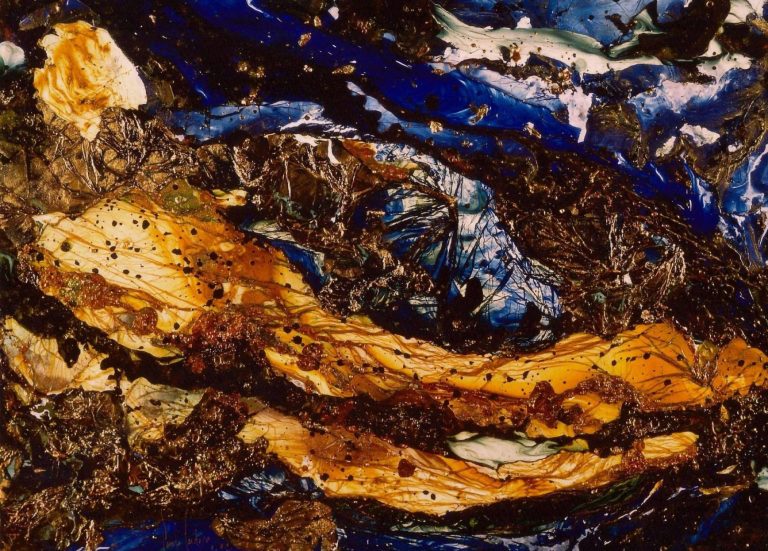
Year: 1993
Technique: mixed technique and gold leaf on canvas
Dimensions: 73 × 100 × 4 cm
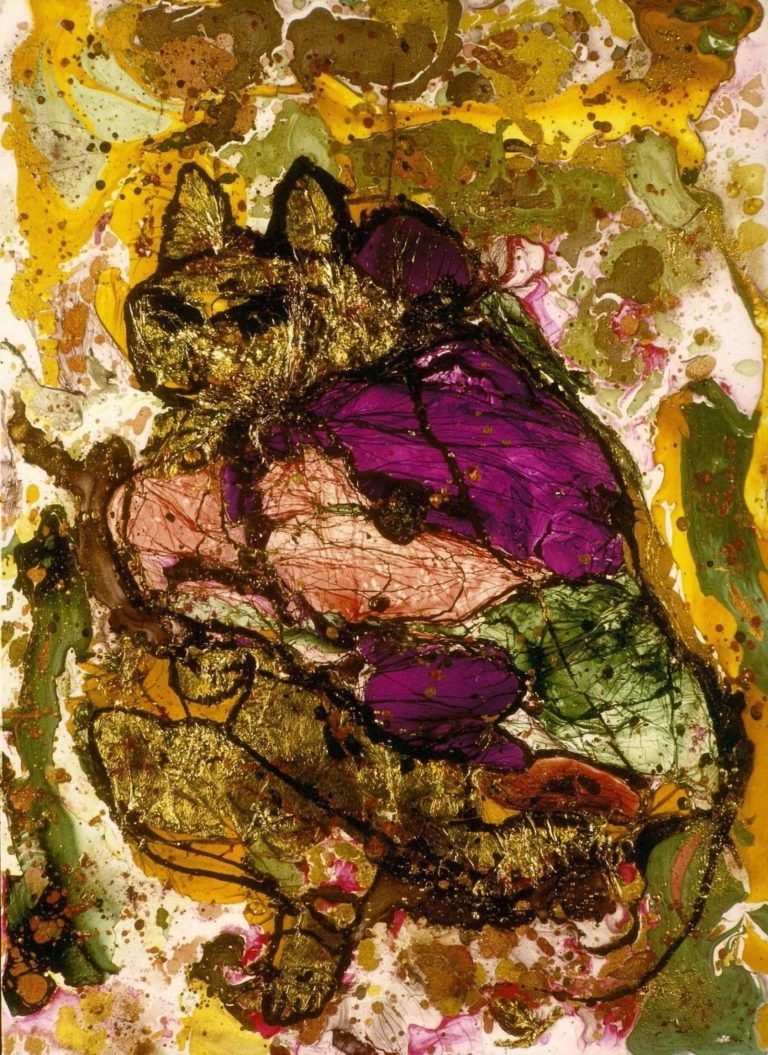
Year: 1993
Technique: mixed technique and gold leaf on canvas
Dimensions: 100 × 73 × 4 cm